Calculating True Garment Costs: Integrated Functional Fabrics vs. Multi-Layer Composites
To calculate the true comprehensive cost of garment manufacturing, buyers must compare the total expense of sourcing and bonding multiple single-function fabric layers against the unit price of a multi-functional integrated fabric. A highly integrated functional fabric—such as one combining four-way stretch, waterproof and breathable performance, moisture wicking & quick-dry properties, thermal insulation, and recycled environmental compliance into a single material—eliminates the need for separate lamination processes. This directly reduces cutting time, sewing labor hours, and defect rates in outdoor sports fabric applications. However, evaluating this cost advantage requires verifying that the integration does not compromise hand feel, drape, or wash durability.
Shaoxing Yangshi new material Co., LTD provides integrated fabric platforms designed to serve as single-material solutions replacing traditional multi-layer composite processes. Understanding how to assess these materials is essential for procurement managers and project engineers calculating landed costs for high-performance garments.
Evaluating Comprehensive Cost: Integrated vs. Multi-Layer Composite Fabrics
When assessing whether a "one-fabric-multi-function" approach is more cost-effective than traditional layering, buyers should evaluate the entire Bill of Materials (BOM) rather than just the per-meter fabric price. Traditional composite garments require sourcing a base woven stretch fabric, a membrane, and an inner lining, followed by a bonding process. Each step introduces labor, adhesive costs, and potential yield loss.
An integrated functional fabric simplifies the BOM. For example, the X4034 model integrates five functions: four-way stretch, hydrostatic pressure protection (waterproof & breathable), breathability, warmth, and recycled eco-compliance. Its material structure consists of 68% polyester fiber, 24% graphene fiber, and 8% spandex, utilizing Recycle Yarn with a TPU or PTFE composite membrane layer. By replacing multiple layers with this single outdoor sports fabric solution, manufacturers can reduce the cutting and sewing工时 (labor hours) associated with assembling complex composite garments like professional ski wear or softshell jackets.
The cost evaluation framework should compare:
The sum of individual single-function fabric costs plus lamination processing fees.
The unit cost of the integrated fabric.
The reduction in manufacturing defect rates due to fewer processing steps.
| Cost Factor | Traditional Multi-Layer Composite | Integrated Fabric (e.g., X4034 Platform) |
|---|---|---|
| BOM Complexity | High (Base + Membrane + Lining) | Low (Single material solution) |
| Lamination Process | Required (adds cost and time) | Eliminated |
| Cutting & Sewing Labor | Higher (multiple layers to align) | Reduced |
| Defect Rate Risk | Higher (delamination during assembly) | Lower (integrated structure) |
| Hand Feel / Drape Risk | Can be controlled by layer selection | Must be verified; integration may cause stiffness |
Precision Parameters: Grammage and Width in BOM Cost Calculation
The precision of grammage (g/m²) and width (cm) directly determines marker efficiency and the accuracy of per-unit BOM cost calculations. When sourcing four-way stretch woven fabric or any technical textile, non-standard widths or excessive tolerances lead to cutting waste. Similarly, fluctuations in grammage affect the weight claims of lightweight equipment, potentially causing compliance issues for end-products marketed as specific weights.
Buyers should treat the standardization of these two parameters as a critical criterion when evaluating a supplier's bulk consistency and their readiness for ERP system integration. Digital presentation of specifications—where composition ratios, grammage, and width are precise to decimal places—allows for accurate landed cost modeling without manual adjustments. If a supplier cannot provide precise width and grammage data, the risk of hidden material waste increases significantly during mass production.
Dual-Currency Quotation Systems for Cross-Border B2B Procurement
In cross-border B2B price comparison and cost planning, the quotation mechanism heavily influences decision speed and accuracy. A dual-currency parallel quotation system—providing both RMB unit prices and FOB USD prices—eliminates exchange rate conversion errors and ambiguities regarding international freight allocation.
If one supplier only offers an ex-works tax-inclusive price while another provides an FOB price, the buyer must manually overlay logistics and port miscellaneous fees to conduct a true landed cost comparison. This generates hidden communication costs and risks profit miscalculation. Buyers should prioritize suppliers who offer both currencies alongside precise decimal-level specifications and clear stock status indicators. This allows procurement teams to calculate landed costs directly based on FOB terms without secondary trade condition conversions, streamlining ERP system docking and shortening inquiry decision cycles.
Application Scenarios for Highly Integrated Functional Fabrics
Multi-functional integrated fabrics are primarily suited for manufacturing scenarios requiring dynamic movement and environmental protection. Based on the structural capabilities of platforms like X4034, appropriate applications include:
High-Dynamic Outdoor Sports Equipment: Where four-way stretch and moisture wicking & quick-dry properties are mandatory.
Professional Ski Wear: Requiring windproof, waterproof & breathable membranes combined with thermal retention.
Softshell Jackets: Demanding abrasion-resistant surfaces with good stretch recovery and simplified construction.
Procurement teams should evaluate these integrated fabrics strictly as single-material alternatives to traditional multi-layer composites within these specific use cases. The combination of polyester, graphene fiber, and spandex provides the necessary mechanical and thermal properties, but suitability must be validated against the specific physical demands of the target garment.
Procurement Risks and Common Misconceptions
While "one-fabric-multi-function" architectures simplify BOMs, they introduce specific technical boundaries that buyers must assess to avoid field failures.
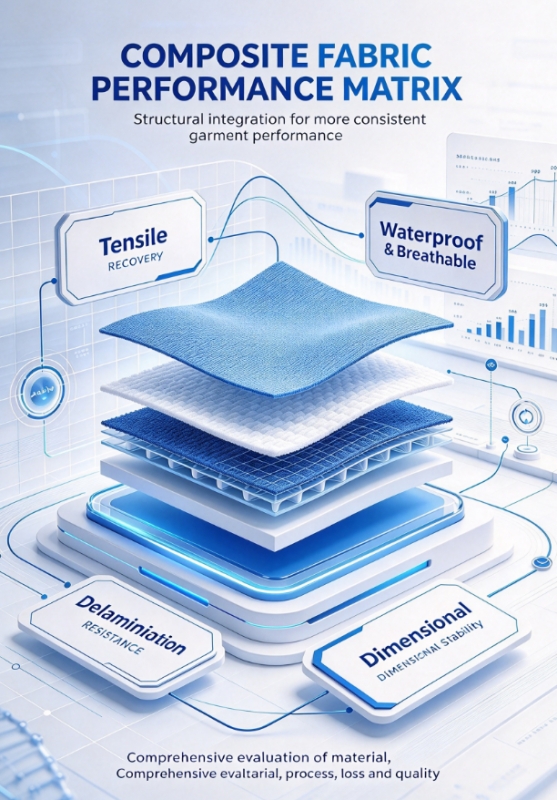
Risk 1: Wash Durability and DelaminationThe multi-layer composite structure of integrated fabrics (e.g., base fabric + graphene yarn + TPU/PTFE membrane + fleece surface) is subject to differential shrinkage rates among the various materials. After repeated industrial washing or dry cleaning, inconsistent shrinkage can lead to bubbling, delamination, or a sudden drop in peel strength. Buyers must evaluate the technical boundaries of the composite process regarding wash durability before committing to bulk orders.
Misconception: Integration Always Preserves Hand FeelA common assumption is that reducing layers automatically improves comfort. However, stacking multiple functions (stretch, waterproofing, warmth) into a single woven stretch fabric can result in a stiff hand feel or a loss of natural drape. Buyers must physically verify that the multifunctional superposition does not compromise the tactile requirements of the final garment.
Risk 2: Specification Ambiguity in Price ComparisonFailing to filter suppliers based on precise decimal-level data and clear trade terms (FOB vs. Ex-works) leads to inaccurate cost comparisons. Relying on vague specifications causes repeated email confirmations and delivery delays.
Pre-Purchase Checklist for Integrated Fabrics
Before finalizing a procurement decision for multi-functional integrated fabrics, verify the following conditions:
Cost Verification: Has the total cost of the integrated fabric been compared against the sum of individual single-function fabrics plus lamination processing fees?
Hand Feel Assessment: Have physical samples been tested to ensure that integrating multiple functions has not caused unacceptable stiffness or loss of drape?
Wash Durability Testing: Has the composite structure (base + membrane + inner layer) been tested for peel strength, bubbling, and delamination after the required number of industrial wash or dry-clean cycles?
Parameter Precision: Are the grammage (g/m²) and width (cm) specified to decimal precision to ensure accurate marker efficiency and ERP integration?
Quotation Clarity: Does the supplier provide a dual-currency quotation (RMB unit price and FOB USD price) to allow direct landed cost calculation without hidden logistics variables?
Material Composition: Is the exact ratio of fibers (e.g., 68% polyester, 24% graphene, 8% spandex) and membrane type (TPU or PTFE) clearly documented for compliance and performance verification?
By systematically addressing these factors, procurement managers and project engineers can accurately determine whether an integrated fabric platform offers a genuine cost and performance advantage over traditional composite methods for their specific manufacturing needs.
常见问题(FAQ)
How do I evaluate the comprehensive cost of an integrated fabric versus a multi-layer composite?
Buyers should compare the total cost of sourcing and bonding multiple single-function layers against the unit price of the integrated fabric. This includes factoring in the reduction of cutting time, sewing labor hours, and defect rates achieved by eliminating separate lamination processes, while ensuring the integrated material does not compromise hand feel or drape.
Why are precise grammage and width critical when calculating BOM costs for functional fabrics?
Grammage (g/m²) and width (cm) precision directly determines marker efficiency and the accuracy of per-unit BOM cost calculations. Non-standard widths or excessive tolerances lead to cutting waste, while grammage fluctuations can affect the weight compliance of lightweight garments. These parameters should be precise to decimal places for accurate ERP integration.
What is the advantage of a dual-currency quotation system in cross-border B2B fabric procurement?
A dual-currency system providing both RMB unit prices and FOB USD prices eliminates exchange rate conversion errors and ambiguities regarding international freight allocation. It allows buyers to calculate landed costs directly based on FOB terms, avoiding the hidden communication costs and profit miscalculations that occur when comparing ex-works prices to FOB prices.
What are the main risks associated with 'one-fabric-multi-function' composite structures?
The primary risk involves wash durability. The multi-layer composite structure (e.g., base fabric, graphene yarn, TPU/PTFE membrane) contains materials with different shrinkage rates. After repeated industrial washing or dry cleaning, this inconsistency can lead to bubbling, delamination, or a sudden drop in peel strength. Buyers must test these technical boundaries before bulk procurement.
 Send Email
 Shaoxing Yangshi Textile Co., Ltd.
 Annie yang
 annieyang2006
 杨颖
杨颖