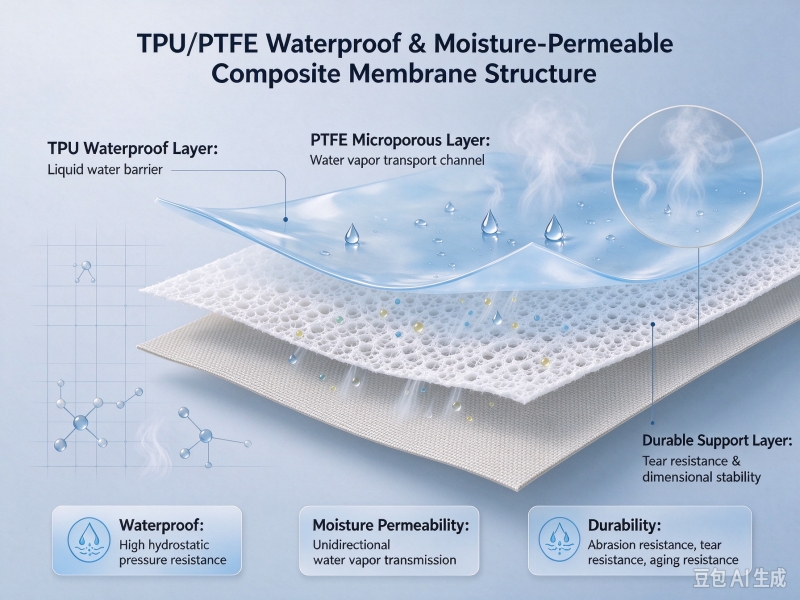
How to Select TPU vs. PTFE Composite Membranes for Waterproof Breathable Laminated Fabric
Selecting between TPU and PTFE composite membranes for waterproof breathable laminated fabric requires evaluating hydrostatic head, moisture vapor transmission rate (MVTR) or evaporative resistance (RET), washing durability, and end-of-life recyclability together rather than treating any single metric in isolation. The choice directly impacts whether an outdoor sport bonded fabric can prevent internal condensation during high-intensity activity while maintaining protection against rain and snow. Buyers sourcing materials for softshell jackets, alpine climbing gear, or workwear must align the membrane type with the target application's metabolic output and regional environmental regulations.
At Shaoxing Yangshi new material Co., LTD, we recognize that waterproof membrane laminated fabric selection is a technical balancing act. This article outlines the parameters, trade-offs, and risk boundaries procurement managers and project engineers need to verify before finalizing material specifications.
Key Parameters for Selecting TPU vs. PTFE Composite Membranes
When evaluating TPU laminated fabric or PTFE-based alternatives, buyers should focus on specific performance parameters that dictate real-world functionality. Waterproof breathable laminated fabric relies on composite film technology applied to a base textile—such as nylon laminated fabric, polyester laminated fabric, or Oxford laminated fabric—to simultaneously achieve water resistance and sweat evaporation.
The primary parameters to compare include:
Hydrostatic Head: Measures the water pressure the fabric can withstand before leaking. Higher values indicate better waterproofing but often restrict breathability.
Breathability (RET/MVTR): RET measures evaporative resistance (lower is better), while MVTR measures moisture vapor transmission rate (higher is better). These metrics define how efficiently sweat escapes the garment.
Washing Durability and Peel Strength: Determines how well the membrane remains bonded to the substrate after repeated wash cycles, which varies significantly between TPU and PTFE structures.
Microporous Breathability Efficiency: The physical mechanism by which the membrane allows vapor transfer while blocking liquid water.
Environmental Degradation Characteristics: PTFE membranes face increasing scrutiny under PFAS restrictions, whereas TPU membranes offer different end-of-life recycling feasibility.
Procurement decisions cannot be based solely on a generic claim of "waterproof and breathable" functionality. The membrane type must be assessed alongside the expected lifespan of the finished garment and the environmental compliance requirements of the destination market.
Balancing Hydrostatic Head and Breathability for Softshell Comfort
For softshell jackets and outdoor sport bonded fabric, hydrostatic head and breathability (RET/MVTR) are mutually constraining parameters. Simply pursuing an extremely high hydrostatic head often comes at the expense of breathability. When breathability is compromised, high-intensity movement generates internal condensation, leading to discomfort and potential hypothermia risks.
To ensure athletic comfort in fleece bonded fabric or mesh laminated fabric constructions used in softshells, buyers must find the optimal balance point based on the target application's metabolic rate. For example, static hiking requires different parameter thresholds compared to high-intensity alpine skiing. Joint evaluation of these two metrics is essential; isolating one for maximization will degrade overall garment performance.
| Application Scenario | Metabolic Output | Recommended Focus | Risk of Imbalance |
|---|---|---|---|
| Static Hiking / Casual Wear | Low | Moderate hydrostatic head, standard MVTR | Over-engineering waterproofing reduces comfort unnecessarily |
| High-Intensity Alpine Skiing | Very High | High MVTR / Low RET, adequate hydrostatic head | High hydrostatic head without sufficient breathability causes severe internal condensation |
| Rain/Snow Workwear | Moderate to High | Balanced hydrostatic head and durability | Ignoring washing peel strength leads to premature membrane failure |
This framework ensures that moisture permeable laminated fabric and windproof & breathable laminated fabric are matched correctly to user needs.
How Application Scenarios Change Material Selection
The base material combined with the breathable membrane laminated fabric alters the final product's characteristics. A tear-resistant laminated fabric designed for alpine climbing equipment demands higher mechanical durability and consistent waterproof membrane performance under stress compared to a standard polyester laminated fabric used for urban outerwear.
Furthermore, the intended use environment dictates regulatory considerations. If the target market enforces strict PFAS limitations, PTFE composite membranes may pose compliance risks regardless of their initial waterproof performance. In such cases, TPU laminated fabric becomes a necessary alternative, provided it meets the required hydrostatic head and RET thresholds for the specific application. Buyers must evaluate the membrane type, the base fabric (e.g., nylon laminated fabric vs. Oxford laminated fabric), and the regulatory landscape concurrently.
Procurement Risks and Common Misconceptions
A significant risk in sourcing waterproof laminated fabric or water-repellent laminated fabric is the over-generalization of "breathable" claims. When marketing materials lack specific RET or MVTR numerical support, the stated breathability function carries a high risk of being misleading.
Different composite membrane structures exhibit vastly different moisture transmission efficiencies. If a buyer procures materials for high-intensity skiwear based only on qualitative descriptions like "highly breathable," the actual sweat evaporation rate may fall far below the human body's perspiration rate during exertion. This discrepancy results in severe internal condensation and cold stress for the end-user.
Another common misconception is comparing prices based purely on the presence of a waterproof breathable function. Because TPU and PTFE membranes differ in washing durability, microporous efficiency, and environmental degradation profiles, treating them as interchangeable commodities leads to incorrect lifecycle cost calculations and potential product failures in the field.
Pre-Purchase Verification Checklist
Before finalizing orders for any laminated fabric or bonded fabric, procurement teams should verify the following conditions to ensure the selected material matches the project requirements:
Confirm exact numerical values for both hydrostatic head and breathability (RET or MVTR); reject qualitative-only claims.
Match the hydrostatic head/breathability balance to the specific metabolic output of the target activity (e.g., static hiking vs. alpine skiing).
Verify the washing durability and peel strength data for the specific membrane type (TPU or PTFE) against the garment's expected lifespan.
Assess the membrane material against target market environmental regulations, specifically checking for PFAS restrictions if considering PTFE.
Evaluate the end-of-life recycling feasibility of the chosen composite structure.
Ensure the base substrate (e.g., nylon laminated fabric, polyester laminated fabric, fleece bonded fabric) is compatible with the membrane's performance profile and the garment's mechanical requirements.
Conclusion and Decision Boundaries
Selecting between TPU and PTFE composite membranes for waterproof breathable laminated fabric is not a matter of identifying a universally superior material, but of matching specific parameters to defined constraints. The optimal choice depends strictly on the joint evaluation of hydrostatic head, RET/MVTR, washing durability, and regional environmental regulations. Buyers must avoid isolating single metrics for maximization and instead apply this balanced framework to ensure the selected outdoor sport bonded fabric performs safely and reliably in its intended application scenario.
(FAQ)
What parameters should buyers prioritize when selecting between TPU and PTFE composite membranes?
Buyers should jointly evaluate hydrostatic head, breathability (RET or MVTR), washing durability (peel strength), microporous efficiency, and environmental degradation characteristics. Relying solely on a generic 'waterproof breathable' claim without specific numerical data introduces significant performance risks.
How do hydrostatic head and breathability interact in softshell jacket fabrics?
Hydrostatic head and breathability are mutually constraining parameters. Pursuing an extremely high hydrostatic head often sacrifices breathability, which can cause internal condensation during high-intensity activities. Buyers must find an optimal balance based on the target application's metabolic output, such as distinguishing between static hiking and alpine skiing.
Are there environmental regulation risks associated with choosing PTFE over TPU membranes?
Yes. PTFE membranes face increasing regulatory scrutiny due to PFAS restrictions in various markets. Buyers must assess the membrane type alongside the target market's environmental regulations and the garment's end-of-life recycling feasibility, rather than comparing materials solely on price or basic functionality.
What is the primary risk of purchasing breathable laminated fabric without specific RET or MVTR data?
Qualitative claims of 'breathability' lacking specific RET or MVTR numerical support carry a high risk of over-generalization. Different composite membrane structures have vastly different moisture transmission efficiencies. Using unverified materials for high-intensity applications like skiwear can result in actual sweat evaporation rates falling far below human perspiration rates, causing severe condensation and cold stress.
 Send Email
 Shaoxing Yangshi Textile Co., Ltd.
 Annie yang
 annieyang2006
 杨颖
杨颖