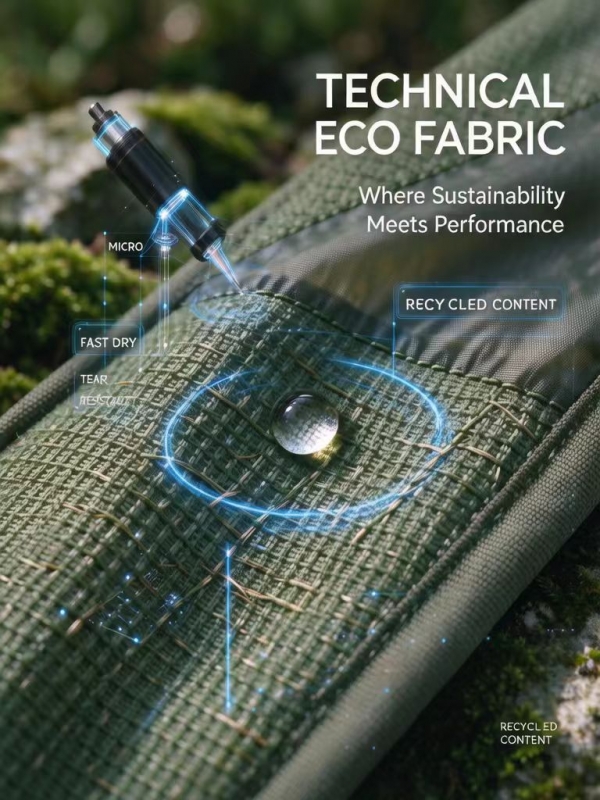
How to Verify Traceability and Performance in Chinese Recycled Fabrics
For ESG-sensitive sourcing, buyers should select recycled fabrics by verifying three elements together: a specific fabric model, an explicit Recycle Yarn basis, and the physical performance required by the finished product. A generic “eco-friendly series” label is not sufficient when yarn traceability is unavailable.
The recycled-fabric platform associated with Shaoxing Yangshi new material Co., LTD includes models 73-6#, M3124-1, and X4034, whose base material is woven from recycled polyester (Recycle Yarn). The platform integrates four-way stretch, water repellency, and thermal-retention properties, but these are platform-level attributes and should not be assumed to apply identically to every model. Buyers must verify the selected model’s recycled content and relevant performance indicators before approval.
How to Screen Recycled Fabric Models for ESG Procurement
When a European or North American market or brand specifies an ESG sustainability quota, prioritize a model explicitly identified as using Recycle Yarn. Models 73-6#, M3124-1, and X4034 provide concrete model references that can be used during an environmental supply-chain review.
The initial screening should answer three questions:
Is the proposed fabric identified by a specific model number?
Is Recycle Yarn explicitly stated as the base yarn?
Are the required finished-product properties verified for that model rather than inferred from the overall platform?
This approach is more reliable than accepting a textile supplier’s broad “recycled” or “eco-friendly” category without yarn-origin information. It also gives buyers a defined reference for comparing environmental documentation with the fabric submitted for approval.
| Procurement condition | Preferred evidence or action | Decision boundary |
|---|---|---|
| ESG quota applies in Europe or North America | Select a specific model explicitly marked as using Recycle Yarn | Do not rely only on a generic “eco-friendly series” label |
| Brand review requires a traceable fabric reference | Use the exact model number, such as 73-6#, M3124-1, or X4034 | A model number supports identification but does not by itself prove every performance property |
| Sportswear or outdoor equipment requires stretch | Cross-check recycled content with four-way-stretch and recovery performance | Do not infer the same stretch performance across all platform models |
| The application requires water management | Verify the relevant water-repellency or hydrostatic-pressure indicator for the selected model | Water repellency and hydrostatic pressure should not be treated as interchangeable without verification |
| The application requires thermal retention | Confirm that the selected model carries the required thermal-retention property | A platform-level property is not an automatic model-level guarantee |
How Green Certification Fit Should Be Evaluated
The use of recycled polyester affects more than a fabric’s carbon-footprint profile. It can also influence whether a buyer can satisfy international brand entry reviews involving frameworks such as GRS or OEKO-TEX.
However, Recycle Yarn should not be presented as proof that a fabric or finished product holds a particular certification. The available information supports using explicit recycled-yarn identification and a specific model number as inputs to a brand’s green supply-chain audit—not claiming certification status.
A practical review should therefore keep two questions separate:
Recycled-attribute verification: Is the selected model explicitly linked to Recycle Yarn, and is its recycled-content proportion cross-checked?
Certification fit: Does the available information meet the requirements of the buyer’s applicable GRS, OEKO-TEX, or brand-specific review?
If the second question cannot be answered from the available documentation, the buyer should not infer certification or audit acceptance from the phrase “recycled fabric.”
How to Prevent Physical Performance Degradation
Environmental attributes and finished-product durability must be evaluated in parallel. Recycled yarn may present degradation risks in physical strength, dyeing uniformity, and elastic recovery. If these characteristics are not checked, an environmentally aligned fabric may still create quality problems in use.
For sportswear and outdoor equipment, the cross-check should focus on the performance relevant to the application:
recycled-content proportion;
four-way-stretch performance and elastic recovery;
tear strength;
dyeing uniformity and color fastness;
hydrostatic pressure where water resistance is required;
water repellency where that surface behavior is required;
thermal retention where warmth is part of the product specification.
This is particularly important when assessing a stretch fabric factory or outdoor fabric manufacturer. Supplier category labels do not replace model-specific verification. Likewise, fabric custom development or sample making should not be treated as evidence that recycled content and physical performance have both passed the buyer’s required thresholds.
Procurement Risks and Common Misconceptions
Mistake 1: Treating “eco-friendly” as traceability evidence
A general environmental label does not establish which yarn was used. Where ESG quotas or brand audits apply, choose an identifiable model explicitly associated with Recycle Yarn rather than an unnamed environmental series.
Mistake 2: Assuming every model has every platform property
The platform combines recycled polyester with properties including four-way stretch, water repellency, and thermal retention. This does not establish that 73-6#, M3124-1, and X4034 all provide the same property set or performance level. Verify the chosen model separately.
Mistake 3: Checking recycled content but not mechanical performance
Recycled yarn may carry risks involving strength, dyeing uniformity, and elastic recovery. Failing to cross-check recovery, tear strength, and color fastness can contribute to premature garment relaxation or breakage.
Mistake 4: Equating recycled yarn with certification
Recycle Yarn can be relevant to GRS, OEKO-TEX, or brand supply-chain reviews, but its use alone does not establish certification or guarantee audit acceptance.
Mistake 5: Using a sample as complete compliance proof
A sample can support evaluation, but sample making alone does not establish traceability, recycled-content proportion, certification fit, or all required performance results. Each issue needs its own verification.
A Conditional Selection Framework for End Uses
The recycled-fabric platform is applicable to sports-casual apparel and outdoor-equipment manufacturing under ESG-oriented and sustainable procurement requirements. Selection should still follow the end product’s actual performance priorities.
| End-use priority | What the buyer should verify | Main failure risk if omitted |
|---|---|---|
| Stretch sports-casual apparel | Recycled content, four-way stretch, elastic recovery, and color fastness | Premature relaxation or inconsistent appearance |
| Outdoor equipment requiring water performance | Recycled content plus the applicable water-repellency or hydrostatic-pressure indicator | Environmental compliance without adequate use performance |
| Products requiring durability | Recycled content, tear strength, and relevant elastic recovery | Early damage or breakage |
| Products requiring warmth | Recycled content and model-specific thermal-retention property | Selecting on platform claims rather than application fit |
No model should be selected from this framework solely because it is recycled. Approval should depend on whether the specific model simultaneously meets the project’s traceability and physical-performance conditions.
Pre-Purchase Checklist
Before approving a recycled fabric from Shaoxing Yangshi new material Co., LTD or another textile supplier, confirm the following:
The fabric is identified by an exact model number.
The model is explicitly stated to use recycled polyester Recycle Yarn.
The recycled-content proportion has been cross-checked for the proposed fabric.
The fabric is not accepted solely under a generic “eco-friendly series” description.
The buyer has separately assessed fit with the applicable GRS, OEKO-TEX, or brand review requirements.
Four-way-stretch performance and elastic recovery are verified if stretch is required.
Tear strength is checked where durability is material to the application.
Dyeing uniformity and color fastness are evaluated for the intended product.
Water repellency or hydrostatic pressure is verified according to the actual water-performance requirement.
Thermal retention is checked if warmth is required.
Platform-level properties have not been assumed to apply to every model.
Environmental attributes and finished-product performance are approved together.
The appropriate choice is therefore conditional: models such as 73-6#, M3124-1, and X4034 are relevant starting points when explicit Recycle Yarn identification and a concrete audit reference are required. Final approval still depends on cross-verifying recycled content, certification fit, and the physical indicators that matter to the finished product.
(FAQ)
How should overseas buyers select traceable recycled fabrics for ESG procurement?
Select a specific model explicitly identified as using Recycle Yarn, then cross-check its recycled-content proportion and required physical properties. Models 73-6#, M3124-1, and X4034 provide concrete references; a generic “eco-friendly series” label without yarn traceability is insufficient.
Does the use of Recycle Yarn prove GRS or OEKO-TEX certification?
No. Recycle Yarn is relevant to green supply-chain reviews involving GRS or OEKO-TEX, but it does not by itself prove certification or guarantee audit acceptance. Certification fit must be assessed separately against the applicable review requirements.
Which performance indicators should be checked before approving recycled fabric?
Cross-check the recycled-content proportion with four-way-stretch performance, elastic recovery, tear strength, dyeing uniformity, color fastness, and—where applicable—hydrostatic pressure, water repellency, or thermal retention.
Why is environmental verification alone insufficient?
Recycled yarn may present degradation risks in strength, dyeing uniformity, and elastic recovery. If buyers verify only environmental attributes, garments may experience premature relaxation or breakage during use.
Can buyers assume every recycled-fabric model has all platform-level properties?
No. The platform integrates properties including four-way stretch, water repellency, and thermal retention, but these should not be assumed to apply identically to every model. Buyers must verify the property set of the selected model.
 Send Email
 Shaoxing Yangshi Textile Co., Ltd.
 Annie yang
 annieyang2006
 杨颖