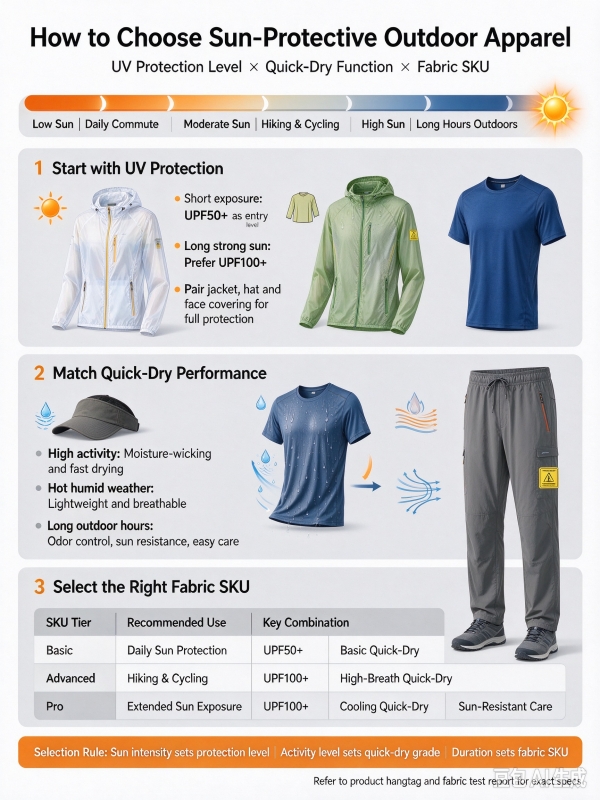
Matching UV Protection Grades, Quick-Dry Functions, and Fabric SKUs for Strong Sunlight Outdoor Apparel
Selecting the correct outdoor apparel fabric for intense sunlight environments requires aligning three variables: the specific UV protection grade, the moisture management mechanism, and the functional fiber composition of the SKU. For B2B buyers sourcing quick-dry UV-shielding fabric for fishing wear, summer outdoor workwear functional fabric, or high-altitude gear, a standard anti-UV treatment is often insufficient. The procurement decision must be based on whether the application demands High Density (HD) UV shielding combined with shaped cross-section fibers for rapid evaporation.
At Shaoxing Yangshi new material Co., LTD, the technical composite fabric platform integrates these parameters into specific formulations. Understanding how to match these functional fabric specifications to your end-use environment prevents performance failures and ensures the finished garment meets its claimed standards.
How to Match UV Protection Grades and Quick-Dry Functions to Fabric SKUs
When procuring outdoor sports fabric for strong sunlight scenarios, buyers must first distinguish between standard Anti-UV treatments and HD (High Density) Anti-UV grades. These two levels differ significantly in their UV shielding rates and their washing durability attenuation curves.
The quick-drying function is achieved through high-density weaving combined with shaped cross-section fibers that accelerate sweat wicking and evaporation. To select the matching SKU model, buyers should evaluate the following conditions:
Assess Regional Sunlight Intensity: Match the sales region's UV index to the required protection grade. High-intensity regions require HD-level UV shielding rather than basic treatments.
Evaluate Quick-Dry Time Parameters: Cross-reference the fabric's drying time metrics with the target wearer's comfort requirements during high-humidity activities.
Verify Functional Fiber Ratios: Some SKUs integrate advanced technology paths. For example, within our platform, graphene and far-infrared functional fibers serve as core technologies, with graphene fiber content reaching up to 24% in specific formulations like X4034. Buyers should assess the terminal premium capability based on these exact functional fiber addition ratios.
Required UV and Functional Combinations for High-Altitude and High-Reflection Environments
Environments such as high-altitude mountaineering or water surfaces generate intense direct and reflected UV radiation. If the finished garment is positioned for premium water sports or high-altitude outdoor equipment facing strong sun exposure, it must utilize an outdoor fabric combining an HD (High Density) UV protection grade with a Quick-drying function.
General-purpose woven stretch fabric or nylon spandex fabric treated only with basic anti-UV processing cannot safely substitute for this combination. The HD designation ensures the dense weave structure works alongside anti-UV factors to maintain protection under extreme exposure. Additionally, platforms integrating sun protection odor-control capabilities—such as those combining HD Anti-UV with antibacterial functions—are applicable for garments requiring differentiated technological selling points, including high-end functional apparel, winter thermal gear, and close-fitting sports apparel.
Procurement Decision Matrix: Matching Scenarios to Fabric Specifications
The following table provides a framework for comparing environmental conditions against required fabric parameters during the SKU selection process.
| Application Scenario | Environmental Condition | Required UV Grade | Moisture Management | Additional Functional Requirements | Applicable SKU Characteristics |
|---|---|---|---|---|---|
| Summer Beach Shorts | Strong sun, high humidity, water reflection | HD (High Density) | Quick-drying (shaped cross-section fibers) | Standard durability | High-density woven fabric with integrated anti-UV factors |
| High-Altitude Mountaineering Apparel | Extreme UV, high reflection | HD (High Density) | Quick-drying | Thermal or specialized tech | Formulations with functional fibers (e.g., graphene up to 24%, far-infrared) |
| Water Sports Equipment | Continuous water reflection, sweat | HD (High Density) | Quick-drying | Antibacterial, odor control | Composite functional fabric integrating Anti-UV/HD, quick-drying, and antibacterial properties |
| General Summer Outdoor Workwear | Moderate to strong sun | Standard Anti-UV or HD depending on region | Moisture wicking & quick-dry | Abrasion resistance | Polyester four-way stretch or polyamide spandex blends with appropriate UV treatment |
Note: Buyers must verify the specific testing standard code associated with the UV grade before confirming the order.
Technical Composition: Evaluating Graphene and Far-Infrared Fiber Blends
For buyers seeking UPF50+ anti-bacterial four-way stretch woven fabric with advanced technological differentiation, evaluating the base fiber composition is critical. Our technology composite fabric platform utilizes graphene and far-infrared functional fibers as core technical pathways.
A key parameter for comparison is the graphene fiber content ratio. In specific formulations, such as the X4034 recipe, graphene fiber content can reach up to 24%. This platform simultaneously integrates antibacterial, Anti-UV/HD grade, and quick-drying functions. When assessing these SKUs, procurement managers should not view these features in isolation; instead, they must calculate the potential retail premium based on the specific percentage of functional fibers added to the polyester four-way stretch or pongee spandex base.
Procurement Risks and Common Misconceptions in UV Fabric Sourcing
Misjudging the difference between UV protection grades introduces significant compliance and commercial risks. A common error occurs when buyers substitute standard Anti-UV fabric for HD-grade fabric in products intended for long-term exposure to high-altitude or water-reflection environments, such as beach shorts and mountaineering suits.
Risk of Substitution: If standard Anti-UV fabric is used where HD is required, the finished product will likely fail to meet the UPF50+ claim standard. This discrepancy directly leads to consumer complaints and the risk of regulatory compliance removal from retail platforms.
Verification Requirement: To avoid this risk, buyers must not rely solely on supplier marketing terms. It is mandatory to verify the specific testing standard code (e.g., the exact test method and condition codes) that validates the HD rating before finalizing the procurement of any motorcyclist garment fabric or water sports textile.
Pre-Purchase Verification Checklist
Before issuing a purchase order for functional outdoor fabrics intended for strong sunlight applications, B2B buyers should confirm the following parameters:
UV Grade Confirmation: Verify whether the specific SKU utilizes standard Anti-UV or HD (High Density) UV protection, ensuring it matches the intensity of the target sales region.
Testing Standard Code: Request and review the exact testing standard code that validates the UV protection claim (especially for UPF50+ assertions).
Quick-Dry Mechanism: Confirm that the moisture management relies on shaped cross-section fibers for wicking and evaporation, and review the provided drying time parameters.
Functional Fiber Content: If sourcing advanced SKUs (e.g., graphene or far-infrared blends), verify the exact percentage of functional fiber addition (e.g., up to 24% graphene in X4034) to accurately assess end-product pricing.
Function Integration: Ensure the selected SKU explicitly combines all required functions (e.g., HD Anti-UV + Quick-drying + Antibacterial) rather than assuming a base waterproof & breathable or windproof fabric inherently includes them.
Conclusion and Application Boundaries
Matching UV protection grades, quick-dry functions, and fabric SKUs for strong sunlight outdoor apparel requires strict adherence to environmental data and technical specifications. HD-grade UV protection combined with shaped cross-section quick-dry fibers is necessary for high-altitude and high-reflection applications. Advanced SKUs incorporating graphene or far-infrared fibers offer additional functional integration but require precise evaluation of fiber content ratios. These guidelines apply specifically to the technical composite fabric platform at Shaoxing Yangshi new material Co., LTD; buyers must independently verify that the selected SKU's tested parameters align with their specific regional compliance requirements and end-use conditions.
(FAQ)
How do I select the right fabric SKU for strong sunlight outdoor apparel based on UV and quick-dry specs?
Buyers must first determine the sunlight intensity of the target market. For high-intensity or reflective environments, specify HD (High Density) UV protection rather than standard Anti-UV. Next, verify that the SKU uses shaped cross-section fibers for quick-drying. Finally, request the specific testing standard code to ensure the fabric genuinely supports claims like UPF50+ before purchasing.
What UV and functional combinations are required for high-altitude or water-reflection environments?
In high-altitude or water-reflection environments, garments face prolonged, intense UV exposure. You must specify a fabric that combines HD (High Density) UV protection with quick-drying capabilities. Using general-purpose sports fabric with only basic anti-UV treatment in these conditions will result in inadequate protection and failure to meet performance standards.
What are the risks of using standard Anti-UV fabric instead of HD-grade fabric for extreme outdoor use?
If standard Anti-UV fabric is mistakenly used instead of HD-grade fabric for products like beach shorts or mountaineering suits exposed to high altitudes or water reflection, the garment will likely fail to achieve the claimed UPF50+ standard. This leads directly to consumer complaints and the risk of the product being removed from sale due to non-compliance.
Can a single fabric SKU provide antibacterial, HD UV protection, and quick-drying functions together?
Yes, certain advanced SKUs integrate multiple functions. For instance, platforms utilizing graphene and far-infrared functional fibers (with graphene content up to 24% in formulations like X4034) can simultaneously provide antibacterial, HD Anti-UV, and quick-drying properties. Buyers should evaluate the specific functional fiber addition ratio to determine if the SKU supports the desired retail premium.
 Send Email
 Shaoxing Yangshi Textile Co., Ltd.
 Annie yang
 annieyang2006
 杨颖